Scalable Field Service Solutions for Medical Device OEMs
How medical device OEMs scale field service with an integrated service partner, centralized dispatch, OEM-certified technicians, and depot repair in one model.
Reading time: 7 minutes
Article Summary: Medical device OEMs scale field service most effectively by partnering with an Integrated Service Partner (ISP) that unifies centralized dispatch, OEM-certified field technicians, and depot repair under one compliant operating model. This approach reduces unplanned downtime, protects brand equity through white-label delivery, and eliminates the regulatory exposure created by fragmented regional vendor networks.
Medical device OEMs are caught in a widening service gap. Demand for reliable, high-quality field service is accelerating faster than manufacturers can build internal capacity, and the consequences reach far beyond uptime. As hospitals, clinics, and labs expand increasingly complex technology portfolios, surgical robotics, advanced imaging, molecular diagnostics, and connected patient monitors, the distance between what OEMs promise in a sales cycle and what they can deliver after installation continues to grow.
Scalable field service is no longer an operational line item, it is a strategic imperative that may impact patient safety, FDA and ISO 13485 compliance posture, service revenue growth, and long-term customer retention.
Why Internal Field Service Teams Hit a Ceiling
Most medical device manufacturers begin with a small in-house field service team, and that model holds up well while the install base is concentrated and the product catalog is narrow. But as portfolios diversify, install bases extend across regions, and New Product Introductions (NPI) accelerate, legacy devices get into their late-stage Product Lifecycle Management phases, service and support becomes increasingly complex.
Why Internal Field Service Teams Hit a Ceiling
Qualified medical device field service technicians are among the hardest technical roles to fill in the U.S. labor market. The Healthcare Technology Management (HTM) sector has faced a multi-year shortage of certified professionals, driven by an aging workforce, limited biomedical engineering technology programs, and aggressive cross-industry competition for electromechanical talent. Recruiting, credentialing, and retaining specialists in every geography where your devices operate has become one of the fastest-growing line items in OEM service P&Ls.
Fragmented Vendor Networks Create Risk
Some OEMs attempt to bridge coverage gaps by contracting fragmented, regional third-party companies, third-parties that may have competing interests or the utilization of distributors in in-direct markets. While this may provide a temporary geographic reach, it introduces serious operational risks:
Administrative Overhead Drains Engineering Resources
A patchwork of regional vendors or distributors demands a disproportionate amount of internal coordination, purchase orders, quality audits, credential verification, insurance tracking, SLA management, and performance reporting across dozens of contracts. Every hour spent managing vendors is an hour diverted from product innovation, service-revenue growth, and customer experience design.
The Integrated Service Partner Model: How It Works and Why It Scales
What is an integrated service partner? An integrated service partner (ISP) is a single provider that combines centralized program management with a nationwide or global network of OEM-trained field service technicians and a unified depot repair operation working directly in OEM Service Management software platforms. The ISP model is the most effective way for medical device OEMs to scale service capacity without scaling headcount, administrative overhead, or compliance risk and maintaining full visibility to data collection and service delivery efforts.
Unlike fragmented vendor networks and distributors that may not accelerate at service, an ISP delivers four compounding advantages:
Centralized Command, Distributed Field Execution
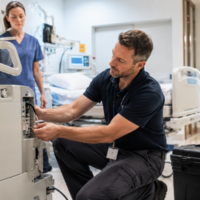
An ISP operates a centralized service operations center that manages dispatching, parts logistics, compliance tracking, and real-time reporting. OEM-certified field service technicians execute installations, preventive maintenance, corrective repairs, and field safety corrective actions; all under consistent standard operating procedures.
The result is the geographic reach of a distributed workforce paired with the accountability of a single, contractually responsible partner with one phone number, one SLA, one audit trail.
OEM-Branded, White-Label Service Delivery
If your service partner isn’t representing your brand consistently at every customer touchpoint, are they truly an extension of your organization, or just another vendor? The best integrated service partners operate as an extension of the OEM's brand. End users at hospitals, clinics, and labs interact with technicians who represent the OEM; following OEM-defined service and quality protocols, wearing OEM-branded attire, and using OEM-approved tools and parts and working within the OEM’s Service Management software. This white-label approach protects brand equity in every customer touchpoint while eliminating the cost and time of hiring direct employees in every market.
Predictive Maintenance and Data-Driven Service
Modern ISPs leverage field service management platforms that go beyond reactive break-fix to predictive, condition-based intervention. By correlating service history, telemetry, parts consumption and failure patterns, they enable predictive maintenance strategies that:
Why Field Service and Depot Repair Must Be Unified
Field service reaches its full potential when tightly integrated with depot repair capabilities. Treating these as separate operations creates information silos that may slow resolution times and increase costs.
Closed-Loop Diagnostics
When field technicians and depot repair technicians share a common platform, diagnostic intelligence flows in both directions. A field technicians documenting symptoms on-site gives the depot team a head start on root cause analysis. Depot findings, including the historically expensive "no fault found" category, flow back to field teams as updated troubleshooting guides, raising first-time fix rates and reducing repeat visits.
Component-Level Repair Reduces Costs
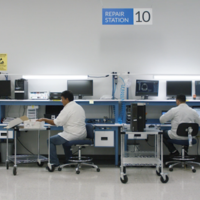
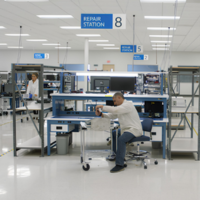
Rather than swapping entire assemblies, a depot repair center with component-level capabilities can refurbish Printed Circuit Boards (PCBs), subassemblies, and modules at a fraction of replacement cost. When that work is performed in-market or in-region rather than shipping FRUs overseas, OEMs compress turnaround time, reduce freight and duty spend, and keep valuable cores inside their own recovery stream. The margin impact on service contracts is direct and significant.
End-to-End Asset Lifecycle Management
A unified field-and-depot model covers every phase of the capital equipment lifecycle: site survey, installation and commissioning, preventive maintenance, corrective repair, refurbishment, relocation, decommissioning, and end-of-life data sanitization. Because every event is logged in a single system of record, compliance documentation is audit-ready at all times, simplifying FDA inspections, MDR filings, and ISO 13485 surveillance audits.
What to Look for in a Medical Device Field Service Partner
Not all service providers are built for the regulatory weight and technical complexity of medical devices. When evaluating potential partners, prioritize these capabilities:
Building Resilience Through Strategic Service Partnerships
In the medical device industry, service quality is inseparable from brand equity. Healthcare providers do not draw a line between the device and the service experience, a poorly maintained ultrasound system or a delayed repair on a patient monitor reflects directly on the OEM, regardless of which entity dispatched the technician.
Partnering with an integrated service provider that specializes in medical device and capital equipment lifecycle management, gives OEMs:
The Bottom Line: Service Scalability Is a Competitive Advantage
Medical device OEMs that treat field service as a strategic asset, not a cost center, consistently outperform competitors in customer retention, service revenue growth, and regulatory compliance. The path to scalable, world-class field service runs through the right integrated service partner.
FAQ: Frequently Asked Questions
What is an integrated service partner (ISP) in the medical device industry?
An integrated service partner is a single provider that combines centralized program management, a nationwide or global network of OEM-certified field service engineers, and depot repair operations under one quality system, enabling medical device OEMs to scale service without adding internal headcount and working within OEM service management systems.
How does outsourcing field service affect FDA compliance?
When the ISP operates under an ISO 13485-aligned quality management system and a documented quality agreement with the OEM, outsourcing preserves and often strengthens compliance by centralizing CAPA handling, complaint management, and device history records for 21 CFR Part 820 and MDR reporting.
What is white-label field service delivery?
White-label field service is a model in which certified technicians from an ISP represent the OEM brand to end users, wearing OEM-branded attire and following OEM-approved service protocols, so hospitals and labs experience a single, consistent brand at every service event.
How much downtime can predictive maintenance reduce?
Mature predictive maintenance programs on connected medical and capital equipment typically reduce unplanned downtime by up to 30%, extend useful life, and lower total cost of ownership for healthcare providers.
Why should field service and depot repair be managed together?
Unifying field service and depot repair closes the diagnostic loop, raises first-time fix rates, reduces FRU swap costs through component-level repair, and creates a single compliance record for the entire asset lifecycle.
What types of medical devices does Quest service in the field?
Quest provides on-site service for Class I, II, and III medical devices used in hospitals, clinics, and laboratories, including imaging systems, infusion pumps, laboratory instruments, and patient monitoring equipment.
What is Quest's typical field service response time?
Response times are defined per OEM program SLA. Quest's 30+ operations centers and strategically located technicians are designed to minimize travel time and equipment downtime, with same-day and next-business-day options available.
Is Quest certified for medical device service?
Yes. Quest is ISO 9001, ISO 13485, ISO 14001, and ANSI/ESD S20.20 certified.
Can Quest support a Field Corrective Action (FCA) or recall?
Yes. Quest manages end-to-end FCAs including planning, logistics, on-site rework, documentation, and reporting at scale.
Does Quest service white-label on behalf of the OEM?
Yes. Quest commonly operates as a branded extension of the OEM's own service team, including uniforms, vehicles, paperwork, and customer communications.
What services are included beyond break/fix?
Installation, integration, preventative maintenance, product upgrades, clinical and end-user training, depot exchanges, and reverse logistics.
How do I engage Quest for a field service program?
Call (800) 231-6777 or email info@questinc.com to scope a program.
About Quest International
Quest International is the leading integrated service partner for medical device and capital equipment OEMs, providing end-to-end field service, depot repair, warehousing / logistics and customer care solutions across North America and globally. With OEM-certified technicians, centralized service operations, and a commitment to service excellence, Quest International helps manufacturers scale their service capabilities without compromising quality or compliance.
Let’s help you measure what really matters, so your customers feel the difference.
Contact us today for a complimentary consultation.
MAR-387 REV 1.0