Field Service: Should You Build an In-House Team or Partner?
For medical device OEMs, field service is where your brand meets your customer. The question many service leaders wrestle with is whether to build and carry that field team in-house or partner with an integrated service provider to deliver it.
Reading time: 8 minutes
Article Summary: For medical device OEMs, the decision to build an in-house field service team or partner with an integrated service provider is really a decision about scale, flexibility, and risk. This guide examines the real costs of in-house staffing, the stakes when field service falls short, and why many OEMs are better served by a hybrid model that combines internal control with flexible external support.
For medical device Original Equipment Manufacturers (OEMs), field service is where your brand meets your customer. A technician on site, fixing a device that a clinic or hospital depends on, is often the most visible part of your company a customer ever sees. The question many service leaders wrestle with is whether to build and carry that field team in-house or partner with an integrated service provider to deliver it.
The short answer: the right model depends less on company size and more on whether your field service capacity can scale with demand. Large OEMs may already have strong internal teams, but new product launches, regional expansion, high service volume, and customer expectations can create more demand than internal resources can absorb alone. Small and midsize OEMs often face the opposite challenge: they need reliable field coverage, training, documentation, and customer support, but may not have the funding, bandwidth, or infrastructure to build a full in-house team from the ground up. In both cases, the core issue is scale. Most OEMs need a model that gives them control where it matters and flexible support where internal capacity falls short.
This guide walks through the real tradeoffs, the costs people tend to underestimate, the stakes when field service falls short, and how to decide what fits your situation.
What does an in-house field service team actually cost?
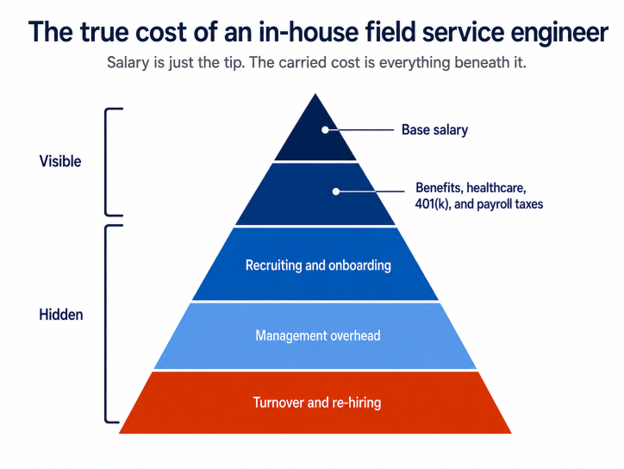
The salary of a field service engineer (FSE) is only the starting number. The full cost of carrying an FSE in-house includes recruiting, onboarding, technical and product training, certifications, benefits, vehicle and travel, management overhead, and the cost of turnover when that person leaves.
That last one is bigger than it looks, and the trap is often the travel. Field service roles frequently require extensive travel, which spreads newly hired technicians thin and burns them out quickly, leading to turnover and the added cost of re-hiring and re-training. You hire to fix a coverage problem, the travel load drives the new hire out within a year or two, and you are back to recruiting, except now you have also lost whatever they learned about your install base.
There is also the utilization problem. A full-time FSE is a fixed cost whether the calls are coming in or not. If your service demand swings with product launches, seasonality, or regional concentration, you end up either overstaffed during slow stretches or scrambling during peaks. Fixed headcount rarely matches variable demand cleanly.
Why is it so hard to hire and keep good field service engineers?
The labor market is the honest answer. The skills and experience needed for medical device field service are hard to find, and the problem gets worse when you narrow the search to a specific region with a limited talent pool. The broader field service industry has felt this for years, with rising service costs and a persistent shortage of skilled technicians as fewer young professionals enter the technical trades.
Two compounding issues make the build path harder than it first appears:
What are the real stakes when field service falls short?
This is where field service stops being a cost-center conversation and becomes a brand and patient-safety conversation. A few of the stakes worth naming plainly:
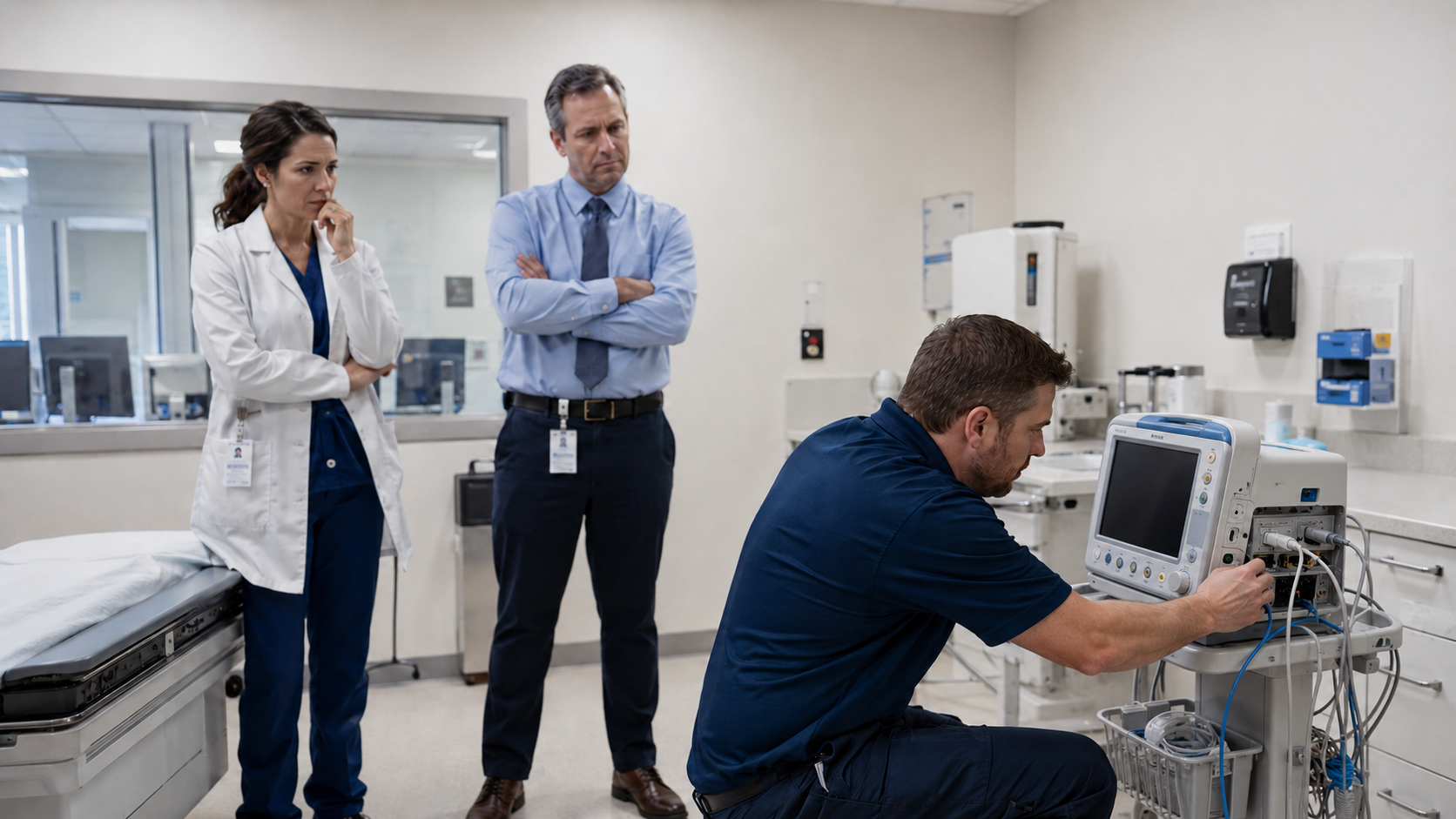
To make this tangible, picture a plausible scenario rather than a real company. A MedTech OEM wins a block of new business in a region where it has no technician within range. To cover it, the company leans on a senior FSE from two states over, piling travel onto someone already stretched. Response times slip, the customer grows frustrated, and within a year the burned-out engineer leaves, taking years of product knowledge with them. Now the OEM is short-staffed in two regions instead of one, recruiting in a thin talent pool, and explaining service delays to a customer whose patients are affected. None of the individual decisions were unreasonable. The model simply could not flex to the demand, and the brand absorbed the damage. This is the failure pattern a partner is built to prevent.
When Does an In-House Field Team Make Sense — And Where Does a Partner Fit In?
Building in-house tends to work when a few conditions line up:
Even in these cases, an in-house team still benefits from hybridized support. A partner can provide an additional layer of coverage to reduce pressure on internal teams, control cost, and create contingency plans when demand spikes or internal resources become unavailable. If technicians leave unexpectedly, even a small partner agreement can help transition workload quickly and keep customers supported without starting from scratch.
Hybrid support also allows OEMs to segment the work more strategically. Internal teams can focus on complex troubleshooting, escalations, proprietary issues, and high-value customer relationships, while a partner supports repeatable work such as installations, preventive maintenance, upgrades, overflow calls, scheduled service, and regional coverage gaps.
The point is not that in-house teams do not work. The point is that there is little downside to having a qualified partner layer in place. It gives OEMs more flexibility, more backup capacity, and a better way to scale without forcing internal teams to carry every service need alone.

When does partnering with a field service provider make sense?
Partnering with an Integrated Service Provider (ISP) tends to win when:
What is the right-sizing advantage?
This is the part that matters most for OEMs unsure whether they are "ready" to commit. A good service partner sizes its team to your actual usage and requirements, not to a fixed contract you have to grow into. You commit to what fits your current volume, and the model flexes as you scale. You are not paying for capacity you will not use, and you are not leaving coverage gaps when demand spikes. Nothing sits over-utilized or under-utilized.
That is the core reason "we are not big enough yet" is usually not a reason to wait. The right partner meets you where you are now and grows with you, which is often more cost-effective than carrying fixed headcount through the uneven early stages of scaling.
How to Structure a Hybrid Field Service Model
Most OEMs do not face an all-or-nothing choice, and in many cases, they should always consider a hybrid model. A hybrid model keeps a core in-house team for the work that benefits from full control, and uses a partner to handle overflow, fill geographic gaps, cover peak demand, and take on scheduled or routine work. This is increasingly the default for OEMs that want both control and flexibility. The work is divided by geography, by task type (scheduled versus reactive), or by product line (legacy versus new), so each piece sits with whoever can deliver it best and most efficiently.
Comparison: In-house team vs. service partner vs. hybrid model
| Factor | In-house team | Service partner | Hybrid model |
| Cost structure | Fixed overhead, paid whether calls come in or not | Variable, scales with actual usage | Fixed core, variable for overflow and peaks |
| Scalability | Slow, limited by hiring pace | Fast, scale up or down with demand | Flexible, partner absorbs the swings |
| Geographic coverage | Strong where you have people, gaps elsewhere | Broad, uses an existing footprint | Own your core regions, partner fills gaps |
| Hiring and retention burden | High, you carry recruiting, travel, turnover | Low, partner owns staffing | Shared, reduced load on your team |
| Knowledge-loss risk | High, knowledge leaves when a key FSE does | Lower, a trained bench does not retire at once | Buffered by the partner bench |
| Compliance and documentation | Yours to build and maintain | ISO-governed QMS, audit-ready records | Partner adds audit rigor to your core |
| Brand control | Full, every interaction is yours | Depends on partner training and standards | High, you keep the brand-critical work |
| Productivity and travel time | Travel-heavy coverage can pull internal teams away from higher-value work | Regional coverage reduces lost travel time | Internal teams stay focused while partner covers travel-heavy work |
How does field service compliance and training work with a partner?
Compliance is often the first concern OEMs raise, and it is a fair one. The right partner operates under a documented, ISO-governed quality management system, trains technicians to your standards, and keeps service records traceable and audit-ready.
Quest International is ISO 9001, ISO 13485, ISO 14001, and ISO 27001 certified, and uses a Master Training (train-the-trainer) model: Quest trainers become certified by training directly under the OEM's subject matter experts, then carry that certification forward to train and scale field technicians autonomously. All Master Training curricula follow OEM guidelines, sit inside Quest's ISO-accredited quality management system, and include scheduled refresher training and retention assurances, which directly addresses the knowledge-loss and consistency problems that make in-house teams fragile. Done properly, a partner can strengthen your compliance posture, since ISO-registered providers undergo regular audits that add a layer of scrutiny and documentation many in-house teams do not maintain on their own.
The Bottom Line
Building an in-house field team makes sense when demand is dense, predictable, and concentrated where you already operate. But even strong in-house teams can reach a point where service volume, customer expectations, regional coverage needs, or sudden workload changes become too much to manage alone.
That is why a partner can make sense in both scenarios. Small and midsize OEMs may need support because they do not have the funding, bandwidth, or infrastructure to build a full field team internally. Large OEMs may already have strong internal teams, but their install base can create so much work that they still need additional support to keep up.
The decision is less about choosing in-house or partner, and more about building the right support model. A hybrid approach gives OEMs internal control where it matters, while also providing flexible capacity for fluctuations, overflow, geographic gaps, installs, PMs, upgrades, and other field service needs.
Quest International delivers field service for medical device and technology OEMs from multiple operations centers worldwide, with a flexible, fractionally allocated workforce that scales with your demand and a Master Training model that protects quality and continuity. If you are weighing how to support your install base, contact us and we can help you think through what fits your install base, your coverage map, and your growth plans.