
The Compounding Gap: Why Top Service Organizations Keep Pulling Further Ahead in 2026
Top service organizations do not pull ahead because of one technology or one standout technician. They build connected operating models that prevent small failures from compounding into repeat visits, downtime, and lost customer trust.
Reading time: 7 minutes
Article Summary: Service performance is becoming one of the clearest ways medical device OEMs differentiate themselves in the market. The organizations pulling ahead are not simply adding new tools or asking technicians to do more with less. They are redesigning service around stronger workflows, better parts readiness, clearer performance visibility, and more effective support for the people doing the work.
The performance gap widens when repeat visits, inconsistent technician coverage, parts friction, and disconnected systems are allowed to compound. Closing that gap requires a practical service strategy that improves uptime, strengthens customer experience, and gives leaders a clearer path to scalable, profitable growth.
Service performance is becoming one of the clearest ways medical device OEMs differentiate themselves in the market. The organizations pulling ahead are not simply adding new tools or asking technicians to do more with less. They are redesigning service around stronger workflows, better parts readiness, clearer performance visibility, and more effective support for the people doing the work.
Why Does the Service Gap Compound?
The service gap rarely begins with one major failure. It builds through small operational problems that repeat every day: a technician arrives without the right part, a service request is routed too slowly, a recurring issue is not captured in the knowledge base, or an experienced technician leaves without transferring critical expertise.
Over time, those issues compound. Repeat visits increase. Resolution times stretch. Customers lose confidence. Internal teams become more reactive, and leaders have less visibility into where service performance is breaking down.
Industry benchmark data shows how large that difference can become. Top-performing service organizations achieve an 86% first-time-fix rate, compared with 53% for lower-performing organizations.1 Aquant also reports that a failed first visit adds an average of two additional visits and can extend resolution timelines by 14 days.1 For medical device OEMs, that gap is not merely an operational metric. It affects equipment uptime, clinical workflow, customer trust, and the ability to retain and grow service relationships.
The goal is not simply to improve one KPI. It is to build a service model where people, processes, parts, and technology work together to prevent small issues from becoming recurring customer problems.
What Defines Top-Performing Service Organizations?
High-performing service organizations do not rely on one technology, one process improvement, or one standout technician. They build an operating model where the entire service ecosystem works together.
Research from Syncron reinforces the business importance of this connection: 80% of OEMs say they plan to increase aftermarket investment over the next five years, while integrated aftermarket operations report stronger revenue growth.4 The window to differentiate through service is open, but it is narrowing as more OEMs invest in parts, pricing, data, and support capabilities.
What Are the Early Warning Signs?
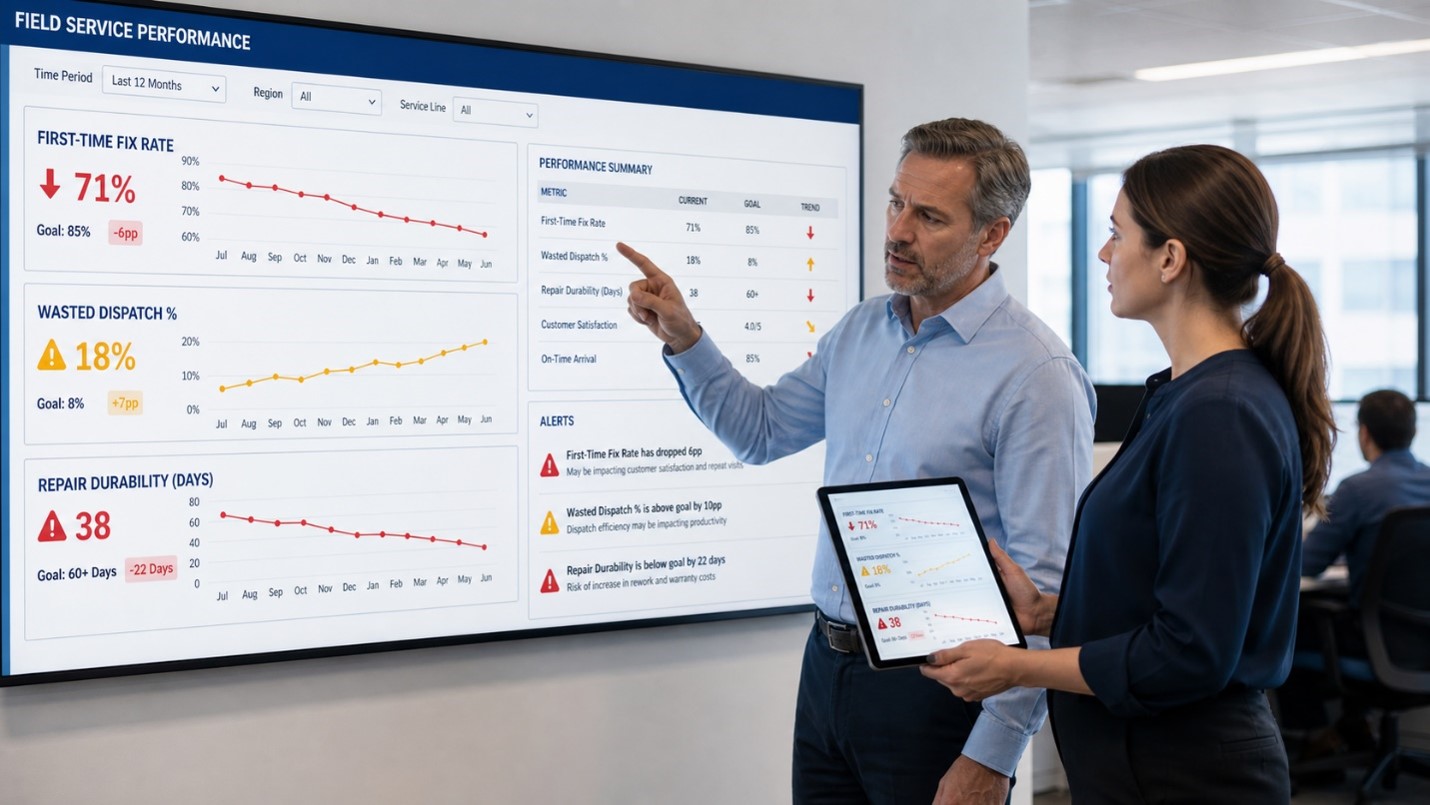
Service performance usually does not decline all at once. It starts with small recurring issues that are easy to explain individually but costly when they become a pattern.
Aquant’s benchmark report found that 14% of onsite service visits are unnecessary, or approximately one in seven truck rolls.1 That is a useful indicator for service leaders: wasted dispatches are often not isolated scheduling problems. They can reveal a broader breakdown in diagnosis, information flow, knowledge access, parts readiness, or escalation design.
What Does a Practical Roadmap Look Like?
Closing the performance gap requires focused, sequenced investment, not a scattershot transformation effort.
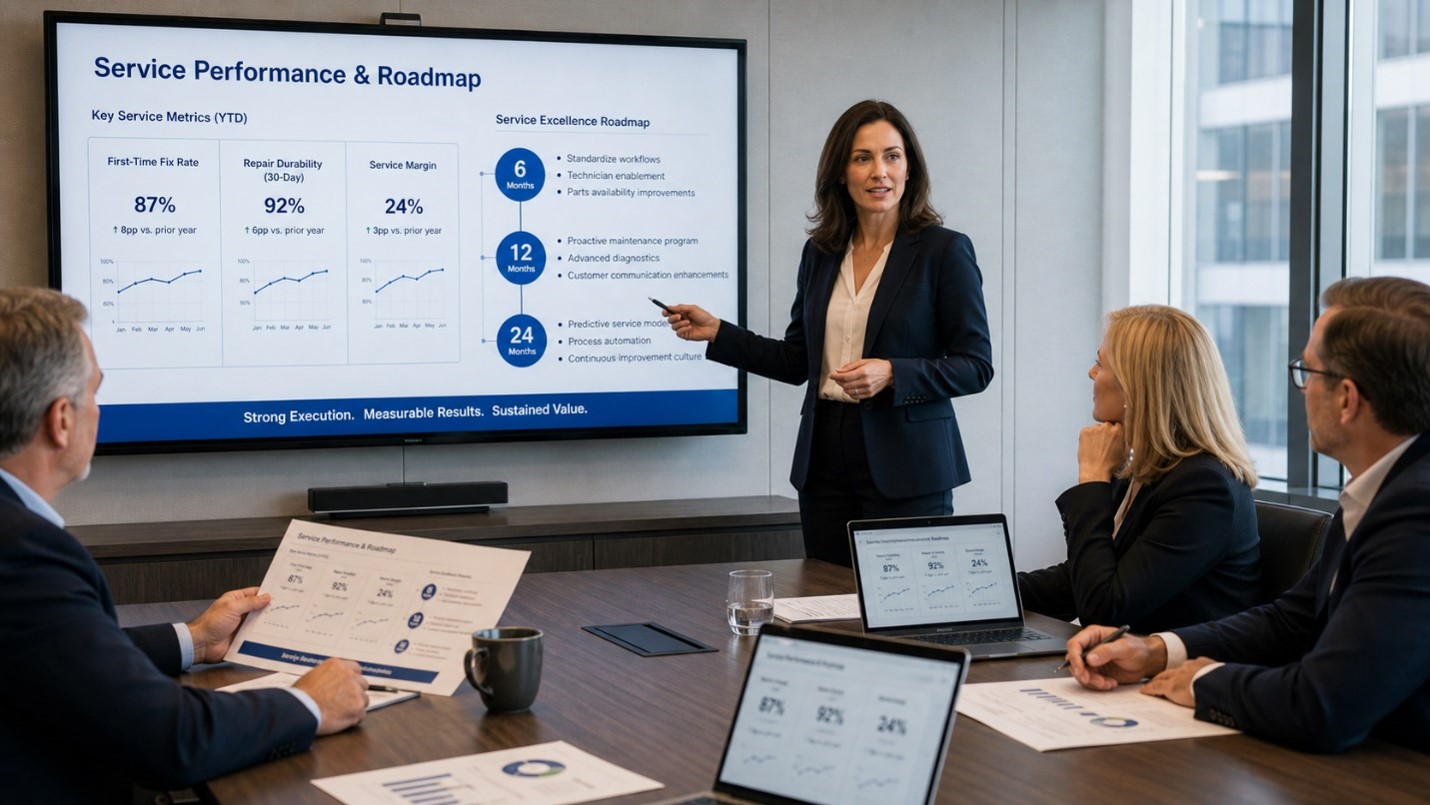
Months 1–6: Stabilize the foundation. Improve first-visit resolution by identifying and addressing the top five root causes of repeat visits. Audit the parts supply chain for availability issues that force return trips. Focus on service history, intake quality, dispatch readiness, repair procedures, parts availability, and escalation pathways before attempting a broad technology rollout.
Implement AI-guided troubleshooting for the highest-volume service categories where reliable data and repeatable workflows already exist. TSIA reports that 71.4% of field-service organizations are investing in AI-guided troubleshooting, showing that this is rapidly becoming a core service capability rather than a niche experiment.2
Months 7–12: Accelerate with AI and analytics. Deploy predictive models where equipment, service, and failure-pattern data supports a shift from reactive to proactive work. Launch AI-assisted onboarding and guided knowledge tools to help technicians find relevant information faster. Build a real-time performance dashboard that tracks first-visit resolution, resolution time, time between visits, repeat demand, wasted dispatches, parts availability, and exception patterns at both team and individual levels.
Months 13–24: Differentiate through orchestration. Integrate field service management, IoT, parts, and AI platforms into a more unified coordination layer that supports outcome-based workflows. Once operational consistency improves, explore outcome-based service offerings that monetize stronger uptime, faster recovery, and better customer experience.
In its aftermarket research, Syncron reports that OEM leaders view aftermarket operations as an increasingly strategic source of stability, profitability, and growth.4 The strategic question is not whether service matters. It is whether the organization can coordinate its data, people, parts, and processes well enough to turn service execution into an advantage.
How Do You Build an Executive Investment Case?
Service leaders often understand where performance is breaking down long before the organization is ready to invest in fixing it. The challenge is translating operational friction into a business case that executives can evaluate and act on.
The strongest investment case starts with the cost of the current state. Repeat visits, delayed resolutions, unplanned parts shortages, technician overtime, customer escalations, and inconsistent service coverage all create measurable financial and operational consequences. Framing those issues as isolated service problems makes them easier to defer. Framing them as risks to uptime, margin, renewal revenue, and customer trust makes the need for action much clearer.
A strong service investment story should show what improvement looks like in practical terms. Define the outcomes that need to improve, identify the operational barriers holding the organization back, and connect each initiative to a measurable result. That may include stronger first-visit resolution, fewer repeat dispatches, improved parts availability, faster technician ramp-up, better repair durability, or clearer performance visibility.
The most effective plans are phased. They establish a baseline, address immediate service risks, and create measurable milestones that demonstrate progress over time. This gives executives a clearer view of what they are funding, how success will be measured, and where the organization can expect to see business impact.
Key Takeaways
Ready to Close Your Service Performance Gap?
If you see early signs of performance drift, now is the time to act—not wait for the next renewal cycle.
Quest International helps medical-device OEMs review field-service performance, identify high-impact opportunities, and build practical roadmaps that can strengthen first-visit resolution, repair durability, uptime, and margin contribution across the service business.
If you are ready to assess your current field-service metrics and design a focused 12-to-24-month roadmap, contact Quest International to compare where field service, depot repair, warehousing and logistics, and customer care support could relieve pressure.
Frequently Asked Questions
How do we know whether our service-performance challenges are structural?
Persistent service issues can indicate underlying opportunities in processes, systems, data, parts planning, workforce enablement, or overall service strategy. A structured assessment can help determine whether performance gaps are isolated or reflect broader operational issues that require a more coordinated response.
Where should a medical-device OEM begin if resources are limited?
The most effective starting point depends on the organization’s installed base, service model, customer commitments, operational priorities, and current performance. Many OEMs begin by identifying the areas with the greatest potential business impact, then developing a focused roadmap that can scale over time.
How quickly can service-improvement initiatives show results?
The timeline varies based on the scope of the opportunity, the maturity of existing systems and processes, and the organization’s ability to implement change. Targeted initiatives can often create early momentum, while broader transformation programs typically deliver value in phases as new capabilities are adopted and refined.
What should an executive team measure to support a service-improvement investment?
Executive teams should focus on the service outcomes most closely tied to customer experience, operational efficiency, revenue protection, and margin performance. The right measurement framework will vary by OEM, but it should connect field-service performance to broader business objectives and financial impact.
Footer/References
[1] Aquant, “2025 Field Service Benchmark Report.” Aquant analyzed nearly 160 service organizations and reported that top performers achieved an 86% first-time-fix rate, compared with 53% for lower-performing organizations. The report also found that 14% of truck rolls were unnecessary, and that a failed first visit added two additional visits on average and extended resolution timelines by 14 days.
[2] Technology & Services Industry Association (TSIA), “The State of Field Services 2026: How AI Restores Humanity.” This source supports the article’s discussion of AI-guided troubleshooting, AI-supported knowledge access, technician enablement, and the move toward more outcome-focused field service. TSIA reports that 71.4% of field-service organizations are investing in AI-guided troubleshooting.
[3] Boston Consulting Group and related aftermarket analyses, “How Aftermarket Services Can Boost Industrial Revenue.” This source informed the article’s broader framing of service and aftermarket operations as strategic contributors to revenue, margin, customer loyalty, and competitive differentiation.
[4] Syncron, “The State of the Aftermarket 2025: Insights from 550 OEM Leaders on the Future of Parts, Pricing, and Performance.” This research reports that 80% of OEMs plan to increase aftermarket investment in the next five years and identifies proactive investment, tighter parts-and-service integration, and data-driven decision-making as important aftermarket priorities.
MAR-XXX REV 1.0